
I’ve sat with this for a few days before deciding to share. Partly because I wanted to choose my words carefully. Partly because I didn’t want to add fuel to the flames of professional tribalism that I feel is becoming more and more prolific within the NHS. But silence also comes at a cost.
Scrolling through Twitter recently, I came across a post from an anonymous doctor who described everyone outside of medicine as the “lanyard class.”
That phrase has stuck with me. On the surface, it might sound like just another throwaway insult in the cesspit of social media. But for me, it represented something much bigger; a mindset that is slowly chipping away at the NHS from the inside.
For those asking…What does “lanyard class” mean? Well, It’s a dismissive label used to imply that unless you wear a stethoscope, your contribution to patient care is somehow ‘less important’. That if you don’t have the “doctor” title, you’re part of a supporting act, rather than a vital role in the system.
It was unnecessary. It was incredibly disrespectful. And it made me stop and think about how many colleagues across the service must feel when they see comments like this almost daily from a series of anonymous medical accounts.
I’ve been privileged to walk in more than one pair of NHS shoes. I started my career as a nurse in adult health. Later, I transitioned into biomedical science.
Both professions gave me unique insights into patient care. Both required years of training, education, and continuous learning. Both came with pressures, responsibilities, and sacrifices that the public rarely see.
Healthcare has changed dramatically in my ten years of exposure within the NHS. Education, training, and technology have expanded the scope of practice across almost every profession. Physiotherapists, pharmacists, radiographers, advanced nurse practitioners, biomedical scientists. All of us are now working at levels that previous generations might never have imagined.
This expansion should be a good thing. It means patients are seen sooner, decisions are made more efficiently, and outcomes are often improved. But here’s the question I keep wrestling with:
Does this growing scope of practice threaten the traditional hierarchy within healthcare?
Because for as long as I can remember, the structure has always been framed as:
Doctor.
Nurse.
Then everyone else below.
But if anything, the pandemic has shone a light on the importance of pathology staff, who contribute to 70-80 % of patient diagnoses and this is still not recognised by trust execs, or the public. Is that archaic view of healthcare still fit for purpose in 2025?
A system, not a hierarchy
The NHS cannot function if we continue to see it as a pyramid with one profession perched at the top. It functions as a system ; a hive of specialities, each with its own unique expertise, designed to operate independently but converge when needed to save lives or improve care quality.
Doctors diagnose and prescribe. Nurses deliver holistic patient care. Biomedical scientists identify life-threatening infections, group blood, prepare histology slides, and carry out genetic testing in the lab. Radiographers provide the imaging that informs treatment. Physiotherapists help patients walk and improve strength and functionality again after devastating illness. The list goes on.
None of us can do this alone! And yet, when colleagues undermine or dismiss the value of others, it doesn’t just bruise egos. It creates real damage to morale.
The hidden cause of low morale
When we talk about low morale in the NHS, the conversation often centres around pay, working conditions, and relentless workload. And yes , those are massive, systemic issues. But there’s another element we don’t discuss enough: the way we treat each other.
The casual disrespect, the passive/aggressive behaviour, The constant undermining. The “us vs them” mentality between professions.
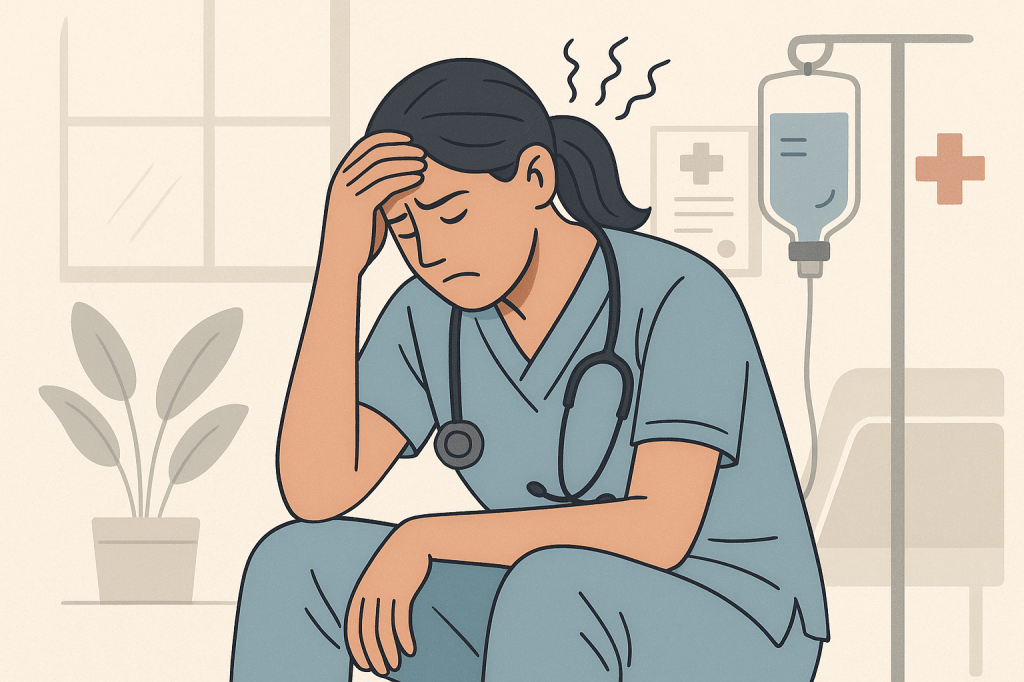
Every time we chip away at someone else’s contribution, we don’t just hurt their morale , we weaken the system as a whole and if I’m honest, I’ve felt it myself very recently . Seeing these posts online, hearing the dismissive comments in corridors, has made me question my own place in the NHS and whether I actually want to continue down this path or seek an alternative career. It has undoubtedly fuelled my own dissatisfaction. At times, it has even made me wonder whether I want to stay at all.
So I ask myself: Are we , through the way we interact with one another, The way we behave contributing to our own disillusionment?
If we truly want to tackle low morale, we can’t just look upwards to “the system.” We have to look sideways at ourselves, our colleagues, our daily interactions. Respect must flow in every direction from consultant to janitor. Recognition must go beyond titles and Collaboration must trump ego.
Because at the end of the day, the patient doesn’t care what lanyard you wear, or what letters sit after your name. They care about whether we worked together to keep them safe. That’s the reminder I try to hold onto when I see those offensive tweets. That’s the perspective I wish we could all keep in mind.
Every role matters. Every voice matters. If we forget that, we risk not only losing staff , we risk losing the very spirit that makes the NHS what it is.
Carl Onwochei
Biomedical Scientist

 The random ramblings of an aspiring BMS